I finally watched this book-turned-movie after giving up on reading the book first.
Plot summary: Girl is dying from cancer. Meets boy who beat cancer. Refuses to date him so that it will hurt him less when she inevitably dies soon. Boy and girl go on an adventure to meet a mutual favorite author across an ocean. They fall in love in a foreign land, despite her best efforts (nothing like the Holocaust to get you in the mood). TWIST: boy reveals his cancer has returned with a vengeance and he ends up being the one of them to die, leaving her broken-hearted.
What I Loved
I’m one of those anti-Hollywood-ending types. When I predict how a movie will end, I want to be wrong. The less happy an ending, the better. I want the acting to make me forget the story is fictional (or at least, re-enacted). I want to be emotionally affected by the story. I want to not be able to stop thinking about the movie, hours after it has ended.
The Fault in Our Stars gave me all that. I was just waiting for Hazel Grace (Shailene Woodley) to eventually die and to watch everyone be sad about it (Marley and Me style). That or Augustus was definitely going to break her heart and ditch her in super-jerk fashion. Maybe immediately post-virginity loss.
The morning after they had sex, they sat down on a bench and Augustus was visibly struggling with the words he knew he had to say. I thought, “Wow, this break up is coming even more quickly than anticipated.” Then, the twist. I loved being wrong! From the introduction of his character, I had accepted his health without question. The return of his cancer caught me off-guard, which made it easier to relate to Hazel Grace, who was equally shocked.
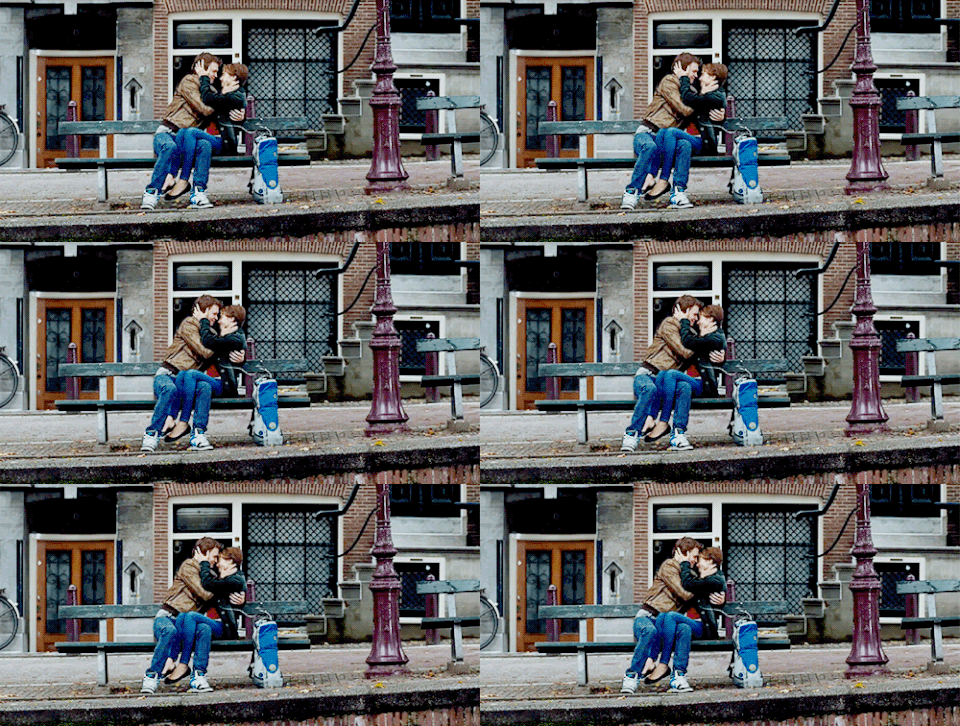
Then there’s the entire premise of “this is not a nice, happy story – this is the real life, and real life is hard.” Hazel’s entire life philosophy and perspective revolved around that, which aligns pretty well with my anti-Hollywood sentiment, so I suppose that spoke to me as well.
The Acting
I’m a huge fan of Shailene Woodley. There’s something in her acting that’s incredibly raw, almost unkempt, that makes it stand out to me. So there was a good chance I was going to like this movie to begin with.
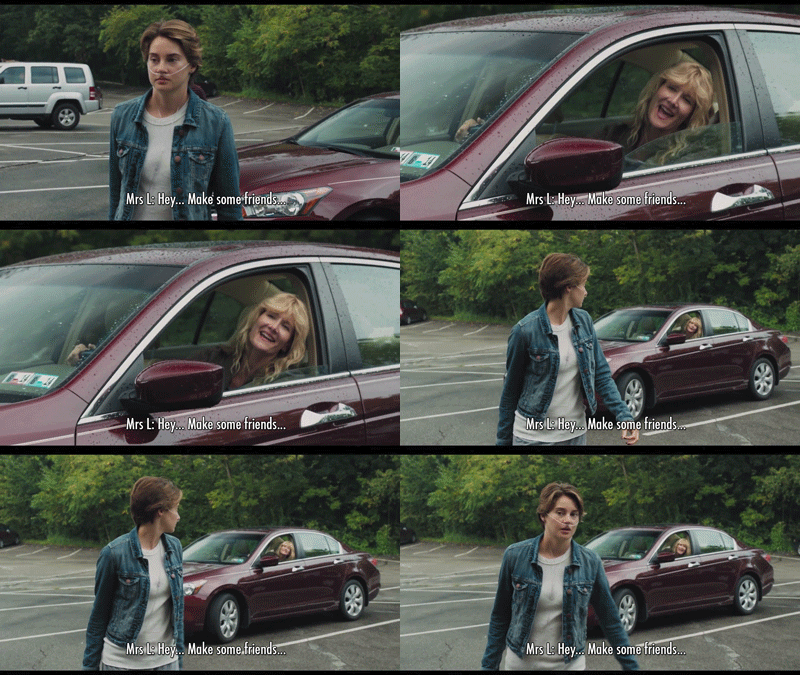
Laura Dern has a fairly spastic vibe to her, which lent itself well to the character of a mother dealing with a dying child. One minute forcing food on her and making her go to a support group, followed by surprising Hazel with a trip to Amsterdam and a beautiful dress to wear on a date in a foreign land: that hard-to-find line of wanting her daughter to live an incredible life while she can, while also holding on desperately – almost to the point of holding her daughter back – in an attempt to keep her alive as long as possible.
The Subtleties
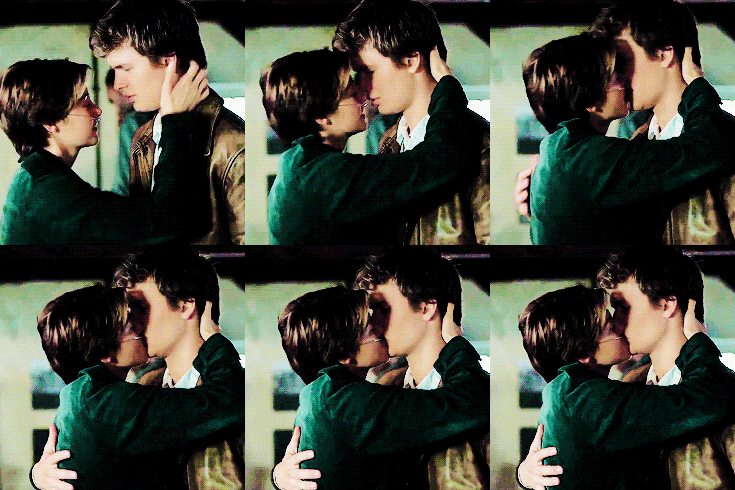
I want to devote a quick paragraph here to the scene in the Anne Frank house. I poked fun at it earlier, noting the strange venue of a first kiss. It really isn’t all that strange though. Like Hazel’s cancer (with hugely obvious differences acknowledged), the Holocaust is a terrible part of life that we would wish away if we could. I appreciate the use of humans facing great tragedy to inspire Hazel into appreciating the beautiful parts of life, to inspire Hazel to take that final leap of faith to fall in love. That concept, in my opinion, is an important part of reality as Hazel sees it; the reality that doesn’t always go right, that sucks, and that hurts is still filled with beautiful moments, irreplaceable experiences, and possibilities worth fighting for.
Now onto the subtlety that most impressed me.
An Imperial Affliction by Peter Van Houten is introduced into the story early on and its role is subtle as well as powerful. It begins with her mother using the argument that Hazel reads the same book over and over again to support her theory that Hazel is depressed. In the moment, the comment is practically off-hand and demands no further attention.
Then, there’s a shot of her actually reading the book. Viewers put together the book with the previous comment, but that’s it – end of story (#puns).
Next, the book becomes a way for Hazel to bond with Augustus. Viewers might think that the book’s true role in the story – to connect the eventual lovers – has been revealed. Plus, it serves as a starting point to discuss Augustus’, Ian’s, and Hazel’s experiences with cancer. Both of these could have been achieved through different means, but this way, though a little unimaginative, certainly works.
When Augustus and Hazel finally meet Mr. Van Houten, Hazel’s rage at not getting her questions answered feels at first a little strange. Who cares that much about a story’s epilogue? As Mr. Van Houten continues on to be a hugely insensitive, rude $(#*@, her rage seems more understandable and appropriate. That original pause disappears amidst the viewer’s own anger.
(Side note – I love that Van Houten turned out to be awful. It felt more realistic. Not because authors are awful people – fingers crossed as I write – but because people and situations usually don’t turn out how we imagine they will, whether worse or better.)
Then Van Houten yells at them on their way out:
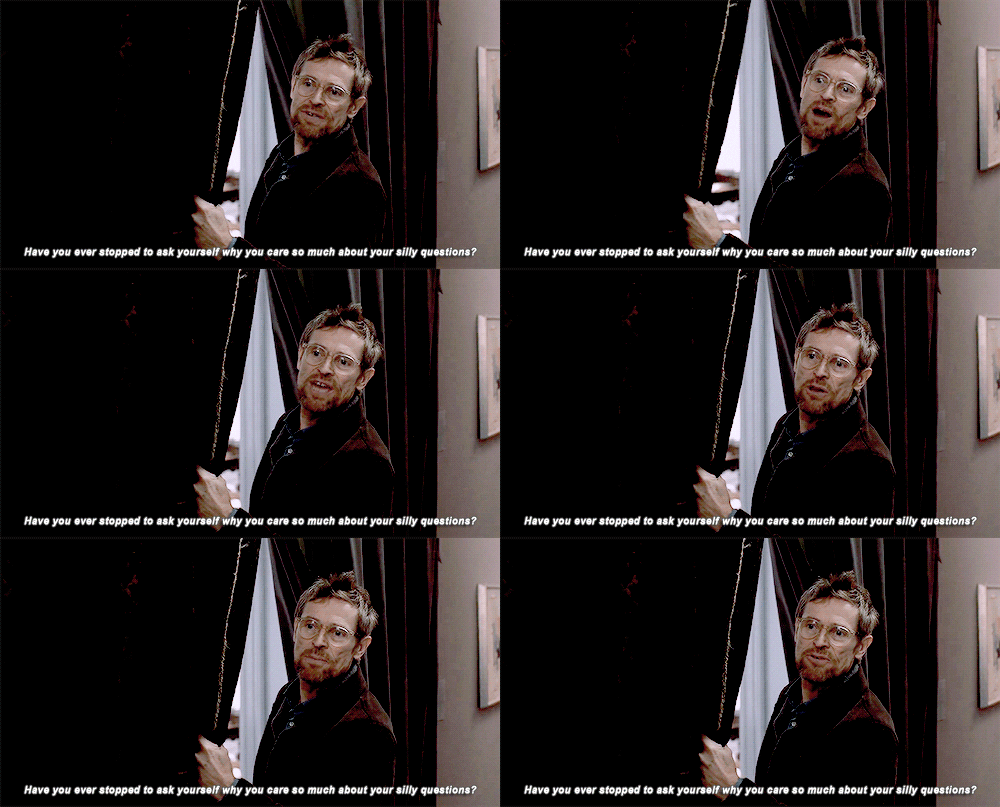
For a moment, the viewer thinks – is that a question I should be asking? There’s hardly any time however to explore this as the movie continues on to the Anne Frank house scene.
Finally, all that build up comes tumbling to the forefront when Hazel confronts her parents about her biggest fear: that when she’s gone, her parents’ and other loved ones’ stories will end, too. Maybe not their lives, but their purpose. That’s why she wants to know what happens to the other characters in the book once the main character dies. Really, she wants to know what happens to the other characters in her life after she dies.
The best part about this parallel is that it is never explicitly drawn. It is laid out for the audience to connect if they’d like to, but it remains their option to find it or not.
The best stories leave a little work up to the audience.
Humor
I have to mention my favorite line that made me burst out laughing: “Between the three of us, we may have 5 legs, 4 eyes, and 2.5 working pairs of lungs, but we also have two dozen eggs, so if I were you, I’d go back inside.”
Reality
A huge theme in this movie is reality, also potentially seen as perspective. From the very beginning, Hazel warns us that this story, this perspective, is not sugar-coated. What she is about to share is reality.
What people want versus what they have is touched on again and again. Two or three different characters mention wanting a different life, a life without cancer – yet that’s not the life they have. Augustus wants to be admired, recognized, and adored by many, but his life ends while he is loved deeply by only a few.

Expectations are also shattered over and over: Hazel’s romanticized version of Van Houten compared to the beast they end up meeting; her preparation for the funeral to honor the dead instead of her execution at the funeral to comfort the living; and finally, her belief that she would die leaving Augustus behind, instead of the other way around.
It’s not about getting what you want or life playing out as you expect. It’s about what you do with what you have and how you react to what life hands you.
Ending
As mentioned, endings make a huge difference to me in movies. For this movie, I was actually not a huge fan of the ending. Augustus communicating with Van Houten who then shows up at his funeral seemed a little inconsistent. To me it felt like a poorly constructed way to get Hazel her eulogy by Augustus. I would have preferred, for example, if Ian had just given it to her. Van Houten’s role in it seemed superfluous, unnecessary, and rushed. It did however give us the awesome line of, “I’m a good person and a shitty writer; you’re a shitty person and a good writer.”
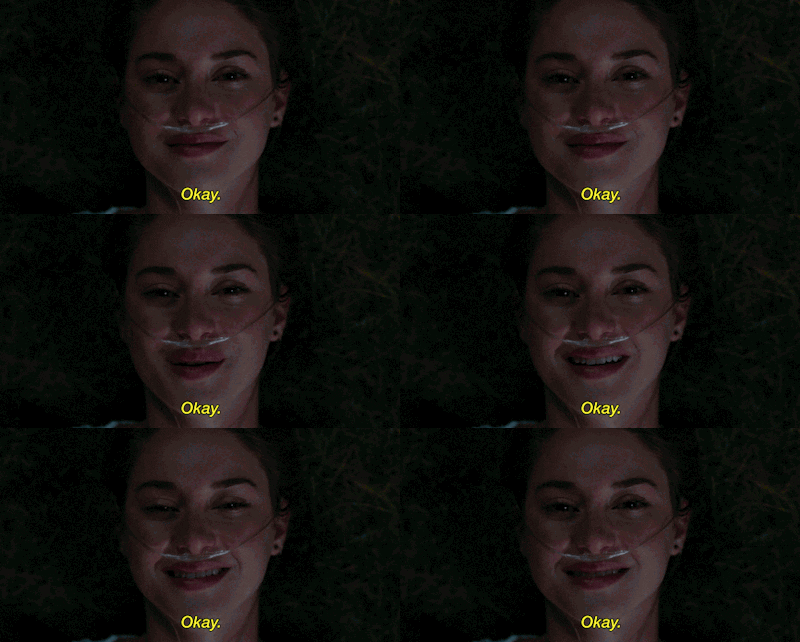
I love, love, loved the idea of ending with their “okay”, but the build-up to Hazel’s last word was lacking for me. Instead of building up the emotions and breaking the dam with that final okay, there was no tension, no movement, no propelling forward; that “okay” landed, and I knew I was supposed to feel a whole hell of a lot, but I just didn’t.
That being said, the ending did not ruin the movie for me. I would still recommend it and watch it again. The rest of the movie was good enough to stand on its own without a ta-da ending. It was just my least favorite part.
The Messages
Though the movie provides many messages with many interpretations, here’s what I’d like to focus on.
Since Hazel was diagnosed, she has been taught by doctors, guided by her parents, and learned from experience a variety of ways to not die. This, despite the transfer property of negation and antonyms, does not equate to learning how to live. As it turns out, Hazel is not well versed in the latter – at least, at the beginning of the story. She starts neither dead, nor truly living. In that way, she is as close as we can currently get to undead: the modern zombie.
So how do you live?
You live for today because, with or without cancer, tomorrow is not guaranteed.
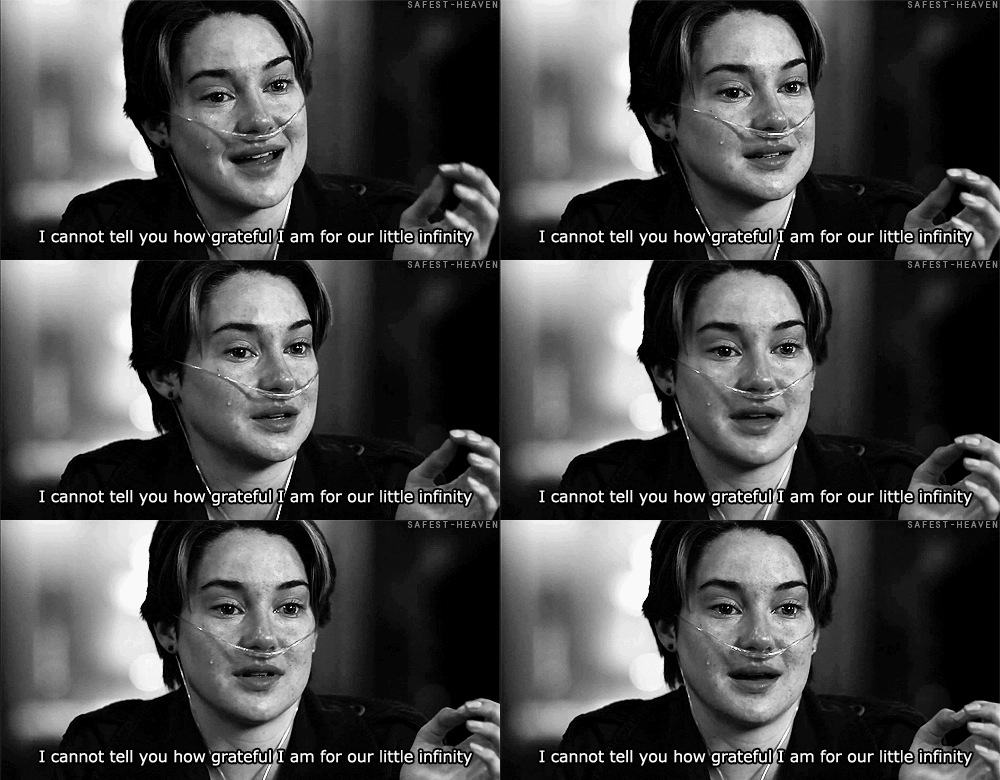
You live with gratitude because, though we could all have more, we could also have less.
Live with patience because you cannot control anyone but yourself.
Live with pain because it demands to be heard; because it’s your body’s way of telling you to deal with something important; because it’s proof that you’re alive.
Live with love because the world is brighter when it is shared.
Live in your infinity; some infinities may be bigger than other infinities, but yours will still last forever.
 Draft Wanderer